

Linda Catalina Cuadros, Josue Alvarez and Isabella Rodriguez
The Rickenbacker Marina referendum went down. So did Fabian Basabe, the scandal-plagued Miami Beach state legislator.
Somebody should ask the MAGA influencers who pushed the ballot measure and Basabe about their return policy.
After dozens of Instagram videos and posts across their other social media channels, Linda Catalina Cuadros, Isabella Rodriguez and Josue Alvarez failed to deliver any meaningful impact on local elections.
Miami voters rejected Referendum 3, the Virginia Key marina redevelopment deal, with 65 percent voting no. In the race for State House District 106, Democratic challenger Lucia Báez-Geller defeated Basabe, the Republican incumbent found guilty in July of sexual harassment, battery and defamation in a civil case. The district stretches from Miami Beach to Aventura.
The outcome shows that having a social media audience does not automatically translate to voters at the polls. The trio’s local campaign content generated less engagement compared with their posts about national politics, based on a cursory review of their Instagram accounts.
For instance, Cuadros, who has roughly 212,000 followers on Instagram posted 25 videos between June 15 and election day on Nov.3 about the marina referendum. A majority of the posts generated an average of roughly 48,000 views. With approximately 71,000 followers on Instagram, Alvarez posted 15 videos between Aug. 26 and election day. Those posts averaged around 15,600 views. Rodriguez, whose Instagram account has roughly 11,800 followers, posted seven videos between Sept. 28 and election day that generated an average of nearly 16,000 views.
They were talking to the same like-minded MAGA followers who show up for their national culture-war content, as well as their usual cast of progressive detractors. But there's little evidence that they persuaded a critical mass of voters in Miami and Miami Beach.
You can fill a comment section with people who agree and disagree with you. But the comment section is not a precinct.
Marina campaign hijacked by MAGA
They turned a debate about a marina deal into a MAGA bigotry slugfest.
Referendum 3 should have been solely focused on the argument about public land, private development and whether Miami taxpayers were getting a fair market deal.

Screenshot of Josue Alvarez’s Instagram video attacking Rickenbacker Marina operator Aabad Melwani.
The proposal would have leased approximately 28 acres of city-owned Virginia Key waterfront to a partnership of Suntex Marinas and RCI Marine Group for an initial 45 years, with extensions potentially taking it to 75. The developers proposed roughly $80 million in improvements and a minimum of $2.2 million in base rent.
There were legitimate questions to argue about the finances, environmental protections, public access and the future of the businesses already operating there, as well as the track record of the businesses seeking to take over two publicly-owned marina sites.
Instead, part of the yes campaign’s online messaging turned into incendiary personal attacks about the current marina operator, Aabad Melwani, his restaurant tenant Adam Gersten and Gersten’s employees at Gramp’s Getaway.
A Miami New Times report documented allegations of racist, antisemitic and anti-LGBTQ rhetoric in posts and comment threads associated with the influencers’ referendum advocacy. Some statements came from the creators; others came from their followers.
It also didn't help the pro-marina referendum campaign’s strategy that prominent Miami MAGA Republicans like Miami-Dade Property Appraiser Tomas Regalado and former Miami City Manager Emilio Gonzalez publicly advocated against the ballot measure. Gonzalez made it to last year’s Miami mayoral run-off as President Donald Trump's endorsed candidate. He lost by 19 points to Democrat Eileen Higgins.
The influencers denounced Gonzalez as a RINO, or Republican In Name Only, because he told voters to reject the ballot measure because the rent RCI and Suntex offered didn't reflect today's market value for waterfront commercial uses.
Suntex and RCI’s political strategists “took a nonpartisan issue and made it partisan,” filmmaker and civic activist Billy Corben. said. “And they took the side that is unpopular in the city.”
Corben was not an impartial observer. He served as a social media advocate for the no campaign, posting his own videos documenting past problems at a Suntex and RCI marina in Miami Beach and exposing the cadre of lobbyists with unsavory pasts on the joint venture’s payroll. Corben is close friends with Adam Gersten, the Gramps Getaway owner who co-chaired the opposition committee with his marina landlord, Aabad Melwani.
Corben posted four videos on his Instagram account about the marina referendum between Sept. 2 and election day. The clips averaged roughly 84,000 views. During the same time span. Corben also posted six videos denouncing Basabe as unfit for office that averaged 112,000 views.
So Corben produced less Instagram video content than Cuadros, Rodriguez and Alvarez, yet averaged more eyeballs. “Who was their audience?” Corben said. “Who were they talking to?”
Corben argues the MAGA influencer effort did more than fail to persuade.
“Not only did they not get them one vote, they lost them votes,” he said. “They lost Republican votes. It was a net loss.”
Even someone who performed work for the proponents saw the problem.
Emiliano Atuñez, a political consultant who regularly works with Republican candidates and did what he described as minor campaign work for the developers’ political committee, said the debate should have stayed focused on the existing marina arrangement, restaurant payments and the finances.
“I didn’t think that it was going to lose by that much,” Atuñez told me. “But I knew it was going to be a tough sled once it got partisan.”
That is someone who worked on the proponents’ side identifying the same strategic failure.
Basabe had a problem no Islamaphobic reel could fix
Basabe’s defeat is not evidence that influencers alone sank his campaign. He brought plenty of his own baggage.
A jury found him civilly liable for sexual harassment, battery and defamation in a lawsuit brought by two former staffers and awarded them $450,000. Basabe denies wrongdoing and is appealing.

Linda Catalina Cuadros (wearing grey jumpsuit) confronts Lucia Baez-Geller, Fabian Basabe’s opponent, outside of Miami Beach City Hall voting precinct.
As the election entered the final stretch, Basabe decided it was time to get low and dirty. He launched an offensive designed to falsely paint Baez-Geller as a terrorist sympathizer because her husband is law partners with a Muslim attorney heavily involved in groups that advocate for people who practice Islam.
Cuadros and Rodriguez piled on with a combined 18 Islamaphobic video posts on Instagram degenerating Baez-Geller.
Jeff Garcia, a Democratic consultant who worked on Báez-Geller’s campaign, said voters had learned about Basabe’s problems before the late campaign attacks.
“The first and most obvious reason the MAGA influencer attacks failed against Lucia is that the news media, her campaign and other people were able to let the public know about Fabian’s problems before he started this desperate last-ditch effort to save himself,” Garcia said.
Garcia said his final poll of the race found 58 percent of respondents knew about the jury verdict. That is his campaign’s polling figure, but it helps explain why he viewed the influencer offensive as too little, too late.
The messenger did not fit the audience either, Garcia said, noting that Caudros is not someone who can relate to Miami Beach voters. “You could not find somebody who looks, sounds and talks less like Miami Beach than [her],” Garcia said.
Who is paying for all this influence?
The other unanswered question is whether the influencers received payments from the pro-marina referendum side, but didn't publicly disclose their compensation.
According to campaign-finance records analyzed in a report cited by Miami New Times, Suntex contributed $2.35 million to the referendum committee between July 20 and October 9. The committee paid approximately $1.12 million to Big Tuesday Media for services that included public relations, social media and video production.
The report alleged that Big Tuesday recruited the creators, but it did not produce contracts or invoices establishing individual payments to Cuadros, Rodriguez and Alvarez. It also said the posts it reviewed lacked sponsorship disclosures, while noting that the absence of a label did not, by itself, establish payment or a legal violation.
The controversy over secret payments to influencers is gaining traction nationally. Recently, Republican operative Alex Bruesewitz is calling attention to the business model by admitting on the X social media app that he's paid rightwing provocateur Laura Loomer to push Republican talking points.
“I’ve paid you for tweets before,” he wrote in one of the X posts: “What percentage of your tweets are paid for?”
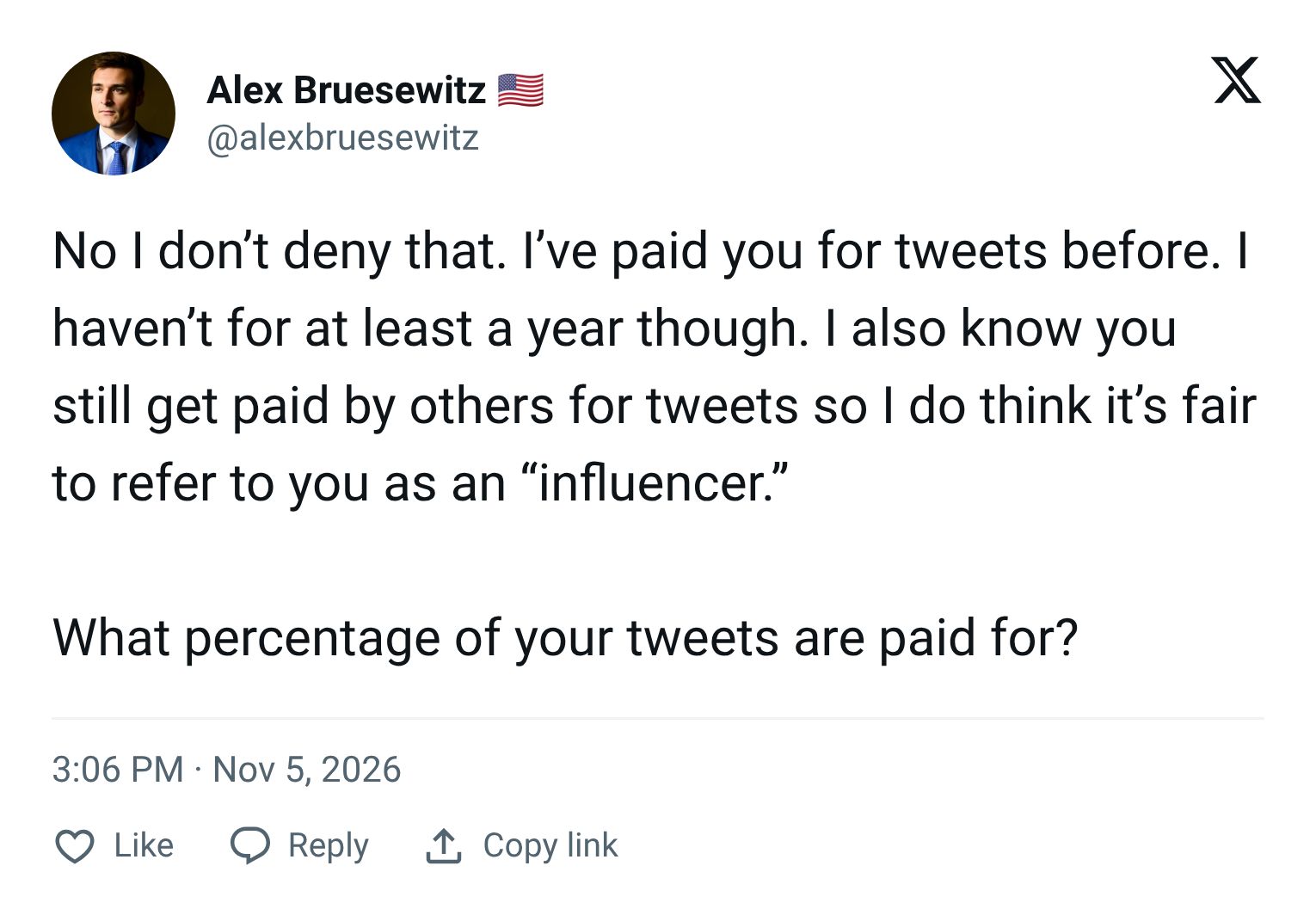
In a longer post, Bruesewitz described an industry in which, he argued, “loyalty has shifted from the agenda to whoever is writing the check.”
His proposed standard deserves attention regardless of what you think of his politics:
“Paid digital advocacy is modern-day lobbying, and it should require disclosure.”
Shortly after his X posts, the Washington Post published a story about Loomer’s alleged pay-to-play arrangements that quoted Bruesewitz and two anonymous Republican operatives who claimed to have also paid Loomer.
Yet, influencers weighing in political races and campaigns is just revving up, according to Garcia. “It’s on full tilt,” he said. “You’re going to see more of it non-stop.”
Indeed, the Miami Young Republicans is hosting a panel discussion on Dec. 3 on combatting Democratic Socialist messaging. Three of the four scheduled speakers are Cuadros, Rodriguez and Alvarez.
Thanks for your support
If you are receiving The Miamian that means that you genuinely care about staying up to date about true crime, corruption and controversy that infects daily life in the Magic City and across the Sunshine State. The Miamian’s purpose to serve as a source of news and analysis about the machinations going on at city halls, government centers, civil and criminal courts.
The Miamian is also a resource where you will find a steady diet of deep-dive, longform journalism about powerful people and how they wield their influence, crime capers involving shady colorful characters and volatile topics that have a direct impact on the daily lives of South Floridians.
Thank you for coming on this journey as a subscriber. Your support will help The Miamian continue growing in reach. We hope you will share The Miamian with your friends and neighbors.
Francisco Alvarado
Share The Miamian!
